
USFans Shipping Calculator: Compare Quotes With the Same Parcel Inputs
A USFans shipping calculator result is useful only when you know the parcel it describes. Two different prices may reflect different dimensions, contents, destinations or included services rather than a cheaper route for the same shipment.
Use the calculator preparation guide to gather your inputs. Then compare the eligible options without changing the parcel halfway through the comparison. This article explains that comparison process; it does not provide a live quotation.
Fix the inputs before comparing the output
Keep the destination country and any requested postal area, packed weight, outer dimensions and contents together. Check whether each input is a measurement or an estimate. A product's listed weight is not necessarily the final parcel weight once protection and outer packaging are included.
If you are comparing two packaging plans, give them separate descriptions. Do not compare one plan's compact dimensions with another plan's lower weight as though that combination already exists.
| Input or condition | Keep consistent when comparing routes |
|---|---|
| Destination | The same country and relevant delivery area. |
| Packed weight | The same parcel estimate or measurement, in the correct unit. |
| Outer dimensions | The same length, width and height, with packaging included. |
| Contents | The actual items and any required characteristics or restrictions. |
| Service scope | The same optional services, or an explicit difference between them. |
| Quote time | Comparable observations, refreshed before the shipping decision. |
Understand why dimensions can change the result
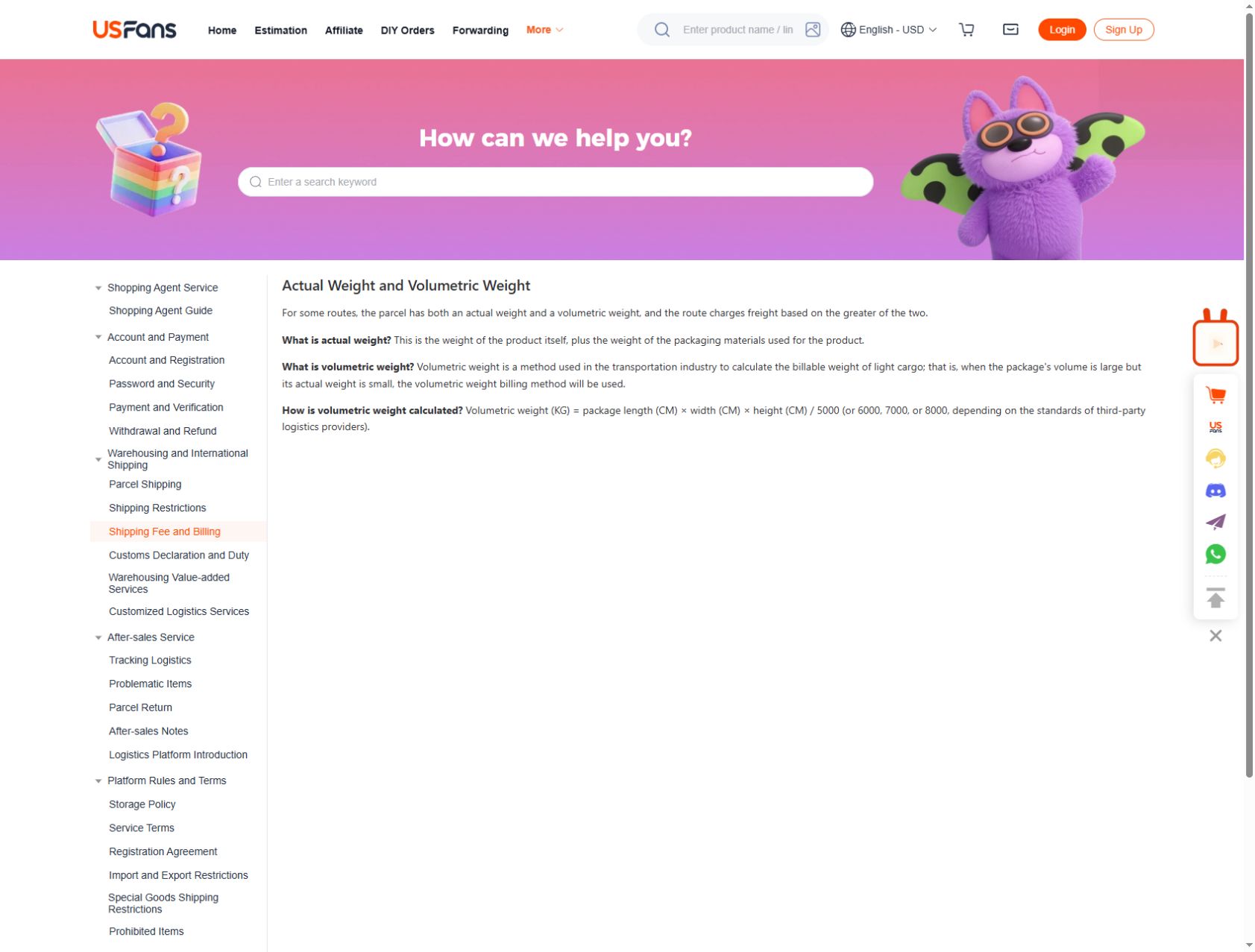
USFans' published explanation of actual and volumetric weight describes routes that charge on the higher of packed actual weight and volumetric weight. Its examples use different divisors depending on the logistics provider. Do not treat one divisor as the rule for every route.
Here is a hypothetical calculation, not a USFans quote: a parcel measuring 40 × 30 × 25 cm has a volume of 30,000 cm³. If a route used a divisor of 6,000, its volumetric weight would be 5 kg. With a divisor of 5,000, it would be 6 kg. If the parcel actually weighed 4 kg and the route charged the higher figure, those two rules would produce different weight bases before pricing or rounding.
Use the selected route's actual rules for a real decision. This illustration supplies neither a freight rate nor a promise that either route is available for your goods.
Compare totals with the same boundaries
Read what the displayed amount includes. Transport, packaging choices and optional services should not be silently mixed with the merchandise price. If a term is unclear, ask about the specific quote rather than filling the gap with assumptions from another buyer's parcel.
Do not infer that a displayed shipping charge includes every possible destination cost. Equally, do not add an imagined charge and present the sum as a verified final total. Keep known amounts and unresolved components distinct while deciding whether the budget is workable.
For a delivery estimate, identify the stage it describes. An advertised transit interval does not automatically include the time needed to obtain products, review warehouse items and prepare a parcel. The delivery-time guide separates those intervals.
Price comes after acceptance
A route that appears inexpensive is not an option until it accepts the parcel's actual contents and destination. If you change what is inside, check again. A previous clothing quote does not answer whether a different category of item can use the same service.
Likewise, do not remove necessary protection solely to reproduce a lower dimensional estimate. Compare realistic packaging plans. A box size copied from a different haul does not establish the dimensions of your proposed shipment.
Apply the comparison to a clothing candidate
Suppose you are considering a hoodie alongside other clothing. Its listing helps identify the candidate, but it does not establish the combined parcel's packed weight or dimensions. Keep the product decision separate until the relevant packaging inputs are known.
Inspect the hoodie candidate on OG
Use the shipping guide for the broader parcel decision and preserve your selections through the spreadsheet links guide. No product photograph substitutes for a measured outgoing package.
Refresh after a material change
Recalculate when the contents, destination, packaging, dimensions or chosen services change. Before payment, review the latest quoted conditions rather than relying on an earlier screenshot with different inputs.
If the result changes unexpectedly, compare the inputs first. Then contact support with the two observations and ask which rule or component explains the difference. Keep addresses and private account details out of screenshots shared publicly.
Common questions
Can I compare shipping by price per kilogram alone?
Only if you understand how that figure was derived and its conditions. A simple average can hide different weight bases and included charges.
Does a lower actual weight always produce a cheaper quote?
No. Dimensions and the selected route's charging rules can also affect the result.
Is the hypothetical 5 kg result my billable weight?
No. It comes from the stated example dimensions and divisor. Your parcel and route require their own inputs and rules.